

Apollo Pricing 2026: Per-Seat Credits and the 3-User Minimum
Apollo prices three axes simultaneously: seats, credits, and add-on dialers. The interaction between them is where the bill compounds.


Bottom line
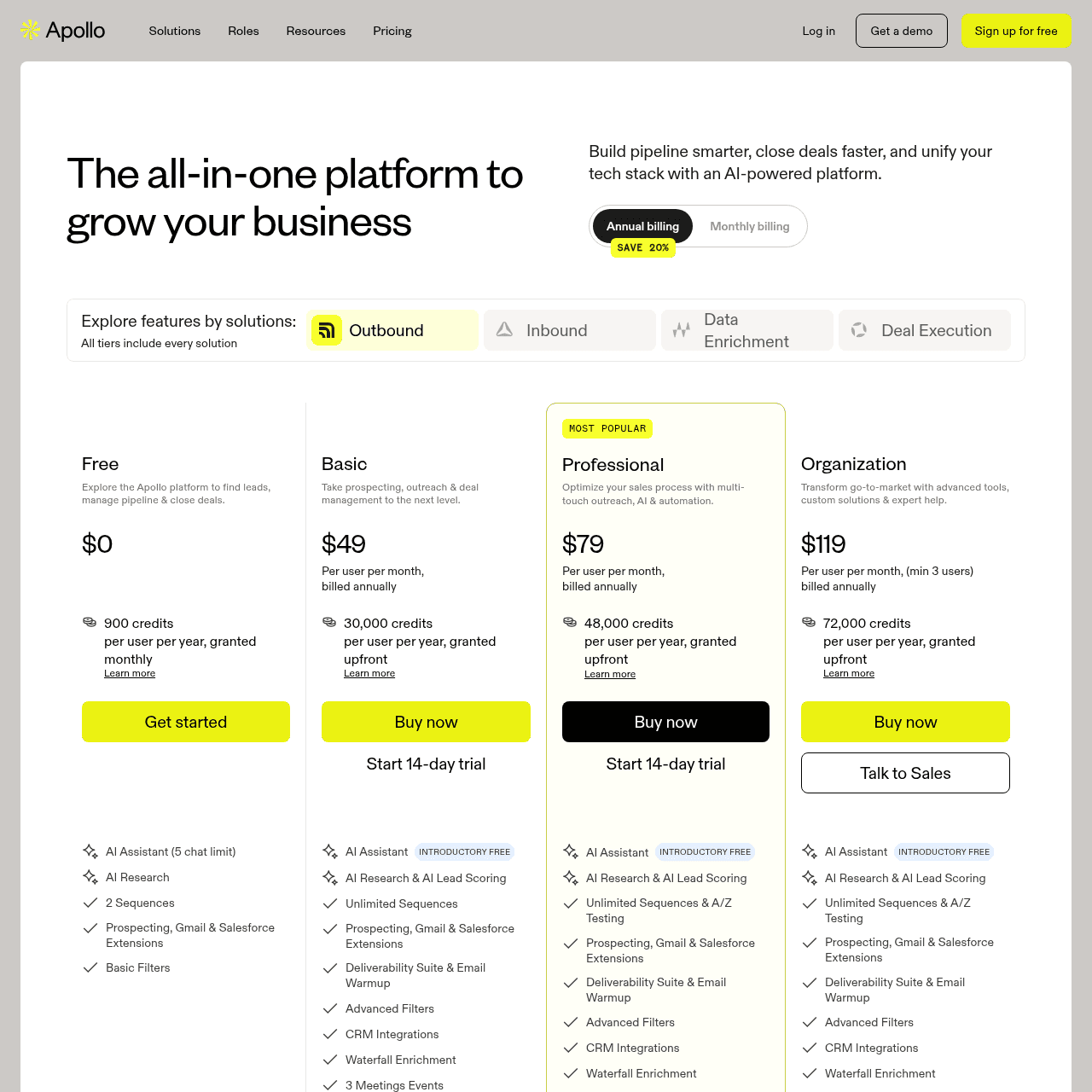
Apollo charges along three axes at the same time, which is unusual in the category. First axis: per seat ($49 Basic, $79 Professional, $119 Organization, each priced per user per month). Second axis: per credit (the data lookups your team consumes from the 275M+ database).
Third axis: per add-on dialer (parallel dialing, international dialing, power dialer). All three compound. The Organization tier carries a 3-user minimum, so the lowest published Organization bill is $357/mo regardless of how many seats you actually need.
The pricing model rewards SDR-led organizations that lean heavily on the database (the credits get used productively and the seat fees amortize across multiple parallel callers). It overprices teams that primarily need sequence sending and treat the database as a sometimes-used utility. The free tier (900 credits per year, 2 sequences) is the most generous in the category for evaluating the data layer specifically, but caps fast on actual sending workflows.
Apollo.io Plans
| Plan | Price | What you get | Watch out for |
|---|---|---|---|
| Free free forever | $0/mo |
|
|
| Basic billed annually | $49/user/mo |
|
|
| Professional billed annually | $79/user/mo |
|
|
| Organization min 3 users, billed annually | $119/user/mo |
|
|
Apollo bill at common team-and-credit configurations
| Usage scenario | Monthly cost | Notes |
|---|---|---|
| Free tier (evaluation) | $0/mo | 900 credits per year = 75 per month effective. Enough to test the data layer; impossible to run real campaigns with the 2-sequence cap. |
| Solo SDR, Basic | $49/mo (annual) | One seat, 2,500 credits per month, unlimited sequences. The economic sweet spot for individual operators doing data-heavy outbound. |
| Solo SDR, Professional | $79/mo (annual) | Adds A/Z testing, US dialer, and 4,000 credits per month. Worth the upgrade when calling is a meaningful part of the workflow. |
| 5-seat Basic team | $245/mo (5 x $49) | Five seats, 12,500 credits per month combined. Works for SDR teams that share a single credit pool by workflow agreement. |
| 5-seat Professional team | $395/mo (5 x $79) | Five seats with US dialer access each. Most common SDR-team configuration. |
| Organization minimum | $357/mo (3 seats x $119) | The 3-user minimum on Organization means even a 2-seat team that needs SSO pays for 3. The implied per-extra-seat cost is $119. |
| Professional + Parallel Dialer add-on | $79/seat + add-on | Parallel Dialer pricing is not publicly fixed; quote-based. Reports cluster around $50-$100/user/mo for the add-on alone. |
How seats, credits, and add-on dialers interact
Apollo prices three things at once and the interactions create non-obvious bill outcomes: Seats. Every paid user on the workspace adds the seat fee ($49, $79, or $119 depending on tier). The seat fee buys access to the sequencer and the database, plus the per-seat credit allocation.
Credits. Each seat ships with annual credits (30K on Basic, 48K on Professional, 72K on Organization). Credits convert to monthly burn at roughly 2,500, 4,000, and 6,000 respectively.
Heavy data prospecting depletes credits faster. Add-on dialers. Parallel Dialer, International Dialer, and Power Dialer each price separately on top of seats.
The US dialer comes free with Professional and Organization. The interaction trap: teams that upgrade from Basic to Professional to "get the dialer included" sometimes find the US-only restriction frustrating and need to add the International Dialer on top, partially negating the upgrade savings.
Key takeaways
- Three pricing axes: seats, credits, add-on dialers
- US dialer comes free from Professional up
- International calls need a separate add-on at every tier
- Heavy data prospecting depletes annual credits in months, not in a year
The Organization 3-user minimum and when it matters
Organization tier requires 3 users minimum, which means the lowest possible Organization bill is $357/mo ($119 x 3) regardless of actual team size. This catches teams in two common scenarios. First: 2-person founder teams who want SSO for security compliance.
They pay for a phantom third seat to get into Organization. The phantom-seat cost is $119/mo annualized, which is a meaningful overhead for early-stage teams. Second: agencies running 4-6 client books who would prefer 4 Organization seats but find the math less favorable than 5 Professional seats.
At 4 seats, Organization is $476/mo vs Professional at $316/mo for the same headcount. The practical rule: Organization makes sense at exactly 3+ seats where you would have provisioned 3 anyway. Below 3 actual seats or above 3 with mixed needs, Professional usually wins on per-seat economics.
Key takeaways
- Organization floor is $357/mo regardless of actual seat need
- 2-person founder teams pay for a phantom third seat
- Agencies often find Professional more cost-effective up to 4-5 seats
- Organization makes sense at exactly the seat count you need
How credits actually deplete during a normal sales month
Apollo credit consumption varies based on what your team does daily. Three common burn patterns: Prospecting-heavy: SDRs running daily list builds against the database burn 300-500 credits per day per person. A 5-person team can deplete the Basic tier annual credits (30K x 5 = 150K) in 60-90 days.
Sequencer-only: teams using Apollo primarily for the sequence builder and rarely pulling new contacts burn closer to 50-100 credits per day per person. Annual allocations last the full year. Mixed: most SDR teams sit somewhere between, burning 150-250 credits per day per person, which fits comfortably in Basic for solo operators and forces an upgrade to Professional or buying additional credits at team scale.
The practical pattern: estimate your monthly burn during the free tier evaluation by tracking actual usage for 30 days, then size your plan against burn-rate, not against advertised credit totals.
Key takeaways
- Prospecting-heavy teams: 300-500 credits per day per seat
- Sequencer-only teams: 50-100 credits per day per seat
- Mixed teams (most common): 150-250 per day per seat
- Estimate burn during evaluation, not from marketing copy
Why all paid Apollo tiers force annual billing
Apollo does not publish a monthly billing option on the paid tiers. All paid plans bill annually upfront. This is a meaningful constraint for teams sizing their commitment.
The practical implications: No trial of paid tiers: you cannot pay for one month of Professional to evaluate before committing to a year. The Free tier is the only no-risk evaluation. Reducing seats mid-term: no pro-rated refund for seats removed during the year.
Hire-and-fire churn cost is real on Apollo. Upgrading mid-term: typically prorates within the same annual contract but verify the exact mechanics with sales before assuming. The forced annual model favors stable teams who know their headcount for the year.
It penalizes seasonal teams, hiring-growth teams, and agencies with churn-prone client books.
Key takeaways
- All paid Apollo tiers bill annually upfront
- No paid monthly option exists
- No pro-rated refunds for mid-term seat reductions
- Free tier is the only no-risk evaluation surface
Keep reading
Got questions? We've got answers.
Free at $0 (900 credits per year). Basic at $49/seat/mo (30K credits/seat/year). Professional at $79/seat/mo (48K credits/seat/year). Organization at $119/seat/mo with 3-user minimum (72K credits/seat/year). All paid tiers bill annually.
Ready to hit primary?
Set up SendKit's isolated infrastructure and start sending in under 15 minutes.
Dedicated IPs on every plan. Cancel anytime.