

Mailforge Pricing: Full Breakdown
Full breakdown of Mailforge pricing per mailbox, the shared IP trade-off, and how it compares to InboxKit and other infrastructure providers.


Bottom line
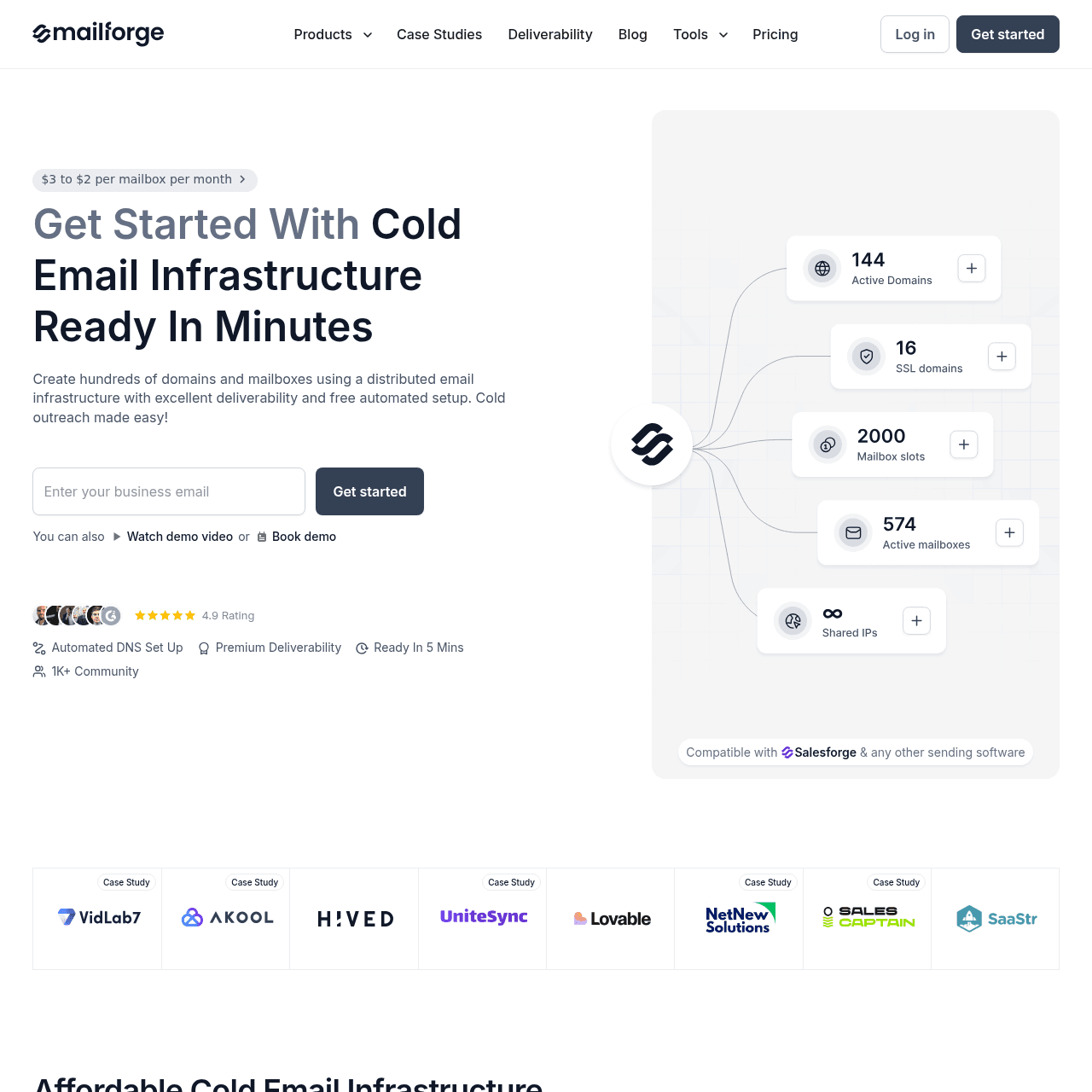
Mailforge is the entry tier of the Salesforge infrastructure stack, priced explicitly for the shared-IP commodity-mailbox segment. The published rate ($2-$3 per SMTP mailbox depending on volume) puts a 200-mailbox fleet around $484/mo, roughly 70 percent cheaper than provisioning the same 200 mailboxes directly through Google Workspace at retail. The pricing model assumes you accept three trade-offs: shared IPs across the customer base (no isolation), no bundled deliverability tooling (warmup, verification, placement testing all live elsewhere), and SMTP-only architecture (no native GWS or M365 option).
Teams already inside the Salesforge ecosystem treat Mailforge as the natural starting point with a clean in-account upgrade path to Infraforge when dedicated IPs become a requirement. Teams shopping cold and comparing across vendor families see less of this structural advantage.
Mailforge Plans
| Plan | Price | What you get | Watch out for |
|---|---|---|---|
| SMTP Mailboxes per mailbox, shared IPs | $2-$3/mailbox/mo |
|
|
Mailforge bill at typical fleet configurations
| Usage scenario | Monthly cost | Notes |
|---|---|---|
| 30 mailboxes, 5 domains | $60-$90/mo | 30 x $2-$3, with SSL and domain masking included. Small fleets land at the higher end of the rate band; the cheapest configuration in the category at this volume. |
| 100 mailboxes, 15 domains | $200-$300/mo | 100 x $2-$3. The volume bracket should drop the rate closer to $2.50 at this scale; confirm with sales. Cheaper than InboxKit ($250) at the low end of the bracket, comparable at the high end. |
| 200 mailboxes, 30 domains | ~$484/mo | 200 x ~$2.42. The publicized 71-percent savings over direct GWS provisioning applies most cleanly at this fleet size. Salesforge's reference configuration. |
| 500 mailboxes, 75 domains | $1,000-$1,250/mo | 500 x $2-$2.50. Above this scale, Mailforge's shared IP architecture starts to feel like a constraint, and most teams begin evaluating the Infraforge upgrade for dedicated IP isolation. |
| Same 200-mailbox fleet upgraded to Infraforge | ~$789/mo | 200 x $3.50 + $99 IP block + 30 x $2 SSL = $789. Roughly 63 percent more than the same Mailforge fleet ($484). The cost gap is the price of dedicated IP isolation within the Salesforge ecosystem. |
Mailforge as the Salesforge ecosystem entry tier
Mailforge is not a standalone product; it is the shared-IP entry tier of the Salesforge infrastructure stack. The pricing strategy assumes most cold email teams start with shared IPs at low cost, grow into needing dedicated isolation, and eventually upgrade to Infraforge ($3-$4 per mailbox plus $99 IP block fee) within the same vendor account. The platform claims 10,000+ businesses on Mailforge, which is the largest customer count in the Salesforge ecosystem and reflects the entry-tier positioning.
The in-account upgrade path is the structural advantage. Moving from Mailforge to Infraforge happens within the existing Salesforge account: same login, same masterbox interface, same DNS automation state, same domain inventory. Mailboxes can be migrated to the dedicated-IP fabric without re-provisioning.
For teams already inside the Salesforge ecosystem (running Salesforge sequences or other Salesforge products), Mailforge is the default starting point because the upgrade path is friction-free. For teams outside the Salesforge ecosystem, Mailforge's pricing is competitive on raw rate but does not benefit from the upgrade-path advantage. The buyer is paying for an entry tier without the future-path value baked in.
Key takeaways
- Mailforge is the entry tier; Infraforge is the dedicated-IP upgrade
- In-account upgrade path means no migration friction
- 10,000+ businesses on the platform reflect entry-tier positioning
- Salesforge-ecosystem buyers extract more value than cold buyers
What Mailforge bundles versus what it does not
Mailforge bundles infrastructure-layer features: automated DNS configuration (SPF, DKIM, DMARC, MX), bulk DNS updates across many domains at once, domain transferring, SSL certificate management, domain masking for tracking link rewriting, and multi-workspace support for separating client books or campaign cohorts. These are the operational features that matter at scale and most providers also include. What Mailforge does not bundle: email warmup, inbox placement testing, email verifier, blacklist monitor.
These deliverability-layer tools are explicitly outside the product scope and have to come from the sending platform or standalone services. The unbundled approach is a deliberate architectural choice: Salesforge treats deliverability tooling as the sending platform's job (their own Salesforge sequencer covers it, and they trust competitors' sequencers to handle it for non-Salesforge users). The pricing implication: teams using a sending platform with native deliverability tooling get the cheap raw mailboxes and pay for nothing they do not use.
Teams running barebones sequencers without bundled deliverability face $75-$200/mo in standalone tool costs that erode the Mailforge cost advantage. The total-cost comparison depends entirely on which side of that line the buyer's sending stack sits.
Key takeaways
- Bundled: DNS, SSL, masking, multi-workspace, bulk updates
- Not bundled: warmup, verifier, placement testing, blacklist monitor
- Salesforge treats deliverability as sending-platform responsibility
- Total cost depends on sending platform's bundled tooling
When Mailforge's pricing model structurally fits
Mailforge fits cleanly for three buyer profiles. First, Salesforge ecosystem buyers running Salesforge sequences who want the cheapest infrastructure tier with the optional upgrade path to Infraforge. The ecosystem alignment makes the in-account upgrade trivial when needed.
Second, mid-volume cold email teams running a sending platform that already covers warmup and placement testing (Smartlead, Instantly, SendKit); the raw mailbox rate is the cheapest path to provisioning 100-500 SMTP mailboxes. Third, cost-driven solo operators and small agencies who can tolerate shared IPs and want to minimize infrastructure spend. Mailforge does not fit cleanly for teams that need bundled deliverability monitoring (InboxKit handles this better at a slightly higher rate), teams that need Google Workspace or Microsoft 365 mailboxes (Zapmail or InboxKit handle these), or teams that already know they need dedicated IPs (Infraforge is the direct path).
The structural fit is "commodity SMTP at scale on shared IPs for teams with deliverability tooling elsewhere."
Key takeaways
- Best fit: Salesforge ecosystem buyers with upgrade path optionality
- Best fit: mid-volume teams with sending-platform deliverability tooling
- Best fit: cost-driven solos and small agencies on shared IPs
- Poor fit: bundled-deliverability buyers, GWS/M365 buyers, dedicated-IP buyers
Keep reading
Got questions? We've got answers.
The shared-IP architecture amortizes IP cost across many senders. One IP pool serves many customers, so each customer's share of the underlying IP infrastructure cost is small. Dedicated-IP architectures (like Infraforge) charge $99/mo per IP block because the IP is allocated to a single customer; the same IP cost is borne by one buyer instead of many.
Ready to hit primary?
Set up SendKit's isolated infrastructure and start sending in under 15 minutes.
Dedicated IPs on every plan. Cancel anytime.